
Indigenous Student PR Scholarship 2025
Colby Holwell, 2025 recipient
From Nain to new narratives: Colby Holwell on communications, creativity, and Indigenous representation
A recent Memorial University graduate, Colby reflects on the courses that shaped the way he sees media, the scholarship that recognized his hard work, and his hope of bringing more Indigenous and Inuit stories to the screen.
At 22, Colby Holwell is already thinking carefully about the stories that shape how people understand the world around them. A recent graduate of Memorial University of Newfoundland, where he completed a Bachelor of Arts in Communications and Media Studies, Colby first imagined a future in journalism, especially sports journalism. Over time, though, that interest began to shift. These days, he feels increasingly drawn to screenwriting and to the possibility of creating stories that connect with people in a deeper, more lasting way. “I’ve always liked storytelling,” he says, “but now I’m thinking more about the kinds of stories I want to tell.
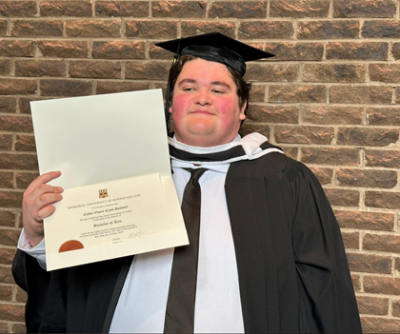
Although he initially imagined a different career path, Colby says it was during his first year that communications began to feel like the right fit. Theory courses stood out immediately, offering a way of thinking that felt both personally meaningful and intellectually engaging. “I just loved it,” he says. What began as curiosity soon became a genuine connection to the discipline and its many possibilities.
One course, in particular, left a lasting impression: Frontiers of Synthetic Media. Focused on artificial intelligence and its impact on media, the class challenged Holwell to investigate what AI systems actually “know” about Indigenous histories and cultures. What he found was troubling. In his research, widely used AI platforms often produced inaccurate or fabricated responses about Indigenous landmarks, cultural knowledge, and traditional Inuit objects. For Colby, the experience was eye-opening. “It showed me how much is still missing,” he says, especially when Indigenous perspectives are absent from the systems shaping public knowledge. The course deepened his belief that AI still has significant limitations and that greater awareness, accountability, and outreach are needed.
That perspective has also changed the way Colby watches and thinks about media. Studying communications sharpened his critical thinking and helped him notice the choices behind how films, television, and other forms of media are made. He became more aware of the layers that creators build into their work — the themes, messages, and cultural signals that might not stand out at first glance. “You start to notice things you didn’t notice before,” he says. For Colby, that shift has made watching a film feel less passive and much more intentional, opening up new ways of understanding both storytelling and the people it reaches.
Receiving a scholarship was a meaningful moment for Colby. After years of hard work toward his degree, the recognition felt like an affirmation that his efforts had mattered. “It made me feel seen,” he says. Beyond the financial support, the award also carried something more personal: a sense of being recognized, encouraged, and celebrated for the work he had put in.
At the centre of Colby’s goals is a simple set of values: kindness and helping others. He traces that outlook to both his family and the close-knit community he grew up in. Coming from Nain, Newfoundland and Labrador, he carries with him a strong sense of community — something that continues to shape how he wants to communicate, create, and contribute. “That’s just how I was raised,” he says. “You help people when you can.”
As he looks ahead, Colby is still figuring out exactly what the next chapter will look like. While he has no immediate plans for further post-secondary studies, film school remains a possibility. For now, he is excited to start writing his own projects, whether for film or television, and to keep developing his creative voice. “That’s where I see myself going,” he says. “I want to keep building something of my own.”
The impact Colby hopes to make is clear: more Indigenous and Inuit representation on screen, and more importantly, more stories created by and for Indigenous people. While progress has been made in recent years, he notes that Indigenous characters have too often been reduced to stereotypes in the past. “I want to help change that,” he says, contributing to a media landscape that is richer, more accurate, and more reflective of Indigenous experiences.
Colby is also quick to express gratitude to the donors and supporters who make scholarships possible. For students, he says, that kind of support means more than financial help — especially at a time when affordability matters so much. “It gives you pride,” he says. It is also a reminder that someone believes in your potential. In many ways, he adds, receiving that support is not just an individual achievement, but a reflection of the people and community who helped make the journey possible. “You don’t get there by yourself,” he says.
About the Indigneous Student PR Scholarship
This scholarship was established in September 2020 for full and part-time students who identify as members of First Nations, Inuit or Métis nations or communities and are working toward a diploma or degree in public relations, communications, social media, or marketing-communications at a recognized community college or university in Canada. The CPRS Foundation partners with Indspire for this National Scholarship Program.

